Communications for biomedical applications

Key Research Areas & Activities​

Biomedical Signal Translation & Encoding​
  • Conversion of acoustic signals into optical signals for neural stimulation.
  • Development of signal processing methods that preserve the perceptual meaning of sound (e.g., frequency-specific stimulation of cochlear regions).
Energy-Efficient & Passive Implant Design
  • Design of fully passive implanted systems that do not require onboard power or DSP units.
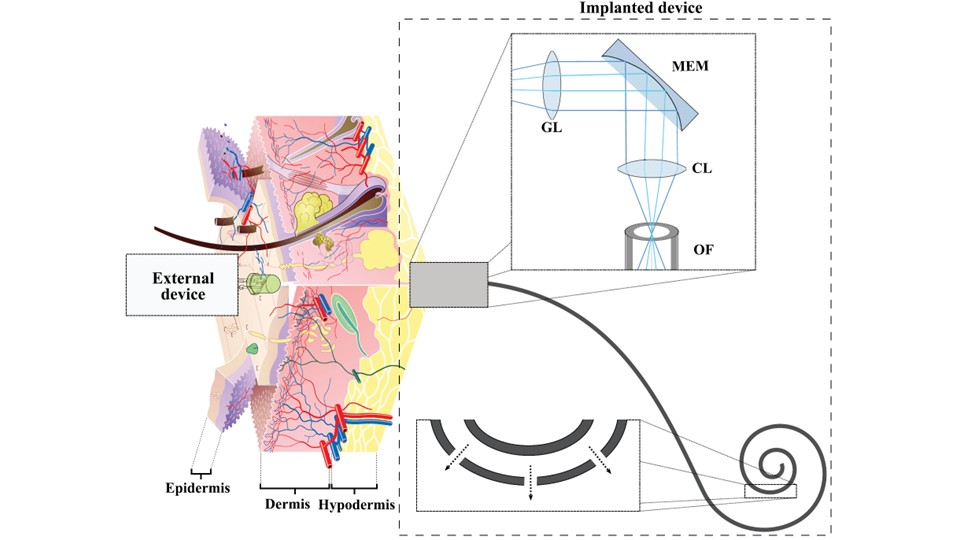
  • Use of passive optical components (lenses, fibers, gratings) to guide and emit light based on wavelength and neural location.
Optical Neural Stimulation & Optogenetics​
  • Use of light to stimulate photosensitive neurons with high spatial and temporal fidelity.
  • Probability of neural damage (safety threshold)

  • Probability of false-hearing (noise-induced stimulation)

  • Probability of neural damage (safety threshold)

  • Investigation of wavelength-specific stimulation (450–600 nm) for targeted neural activation.
Transdermal Optical Communication Channels​
  • Modeling and optimization of skin-channel characteristics (attenuation, scattering, pointing errors).
  • Link budget analysis to ensure sufficient photon flux for neural excitation while ensuring patient safety.
System Modeling & Performance Metrics
  • Development of novel KPIs:
  • Closed-form expressions for photon flux, coupling efficiency, and misalignment effects.
Safety & Green Communication
  • Ensuring optical power levels remain within safe exposure limits (MPE).
  • Comparison with conventional RF-based implants to highlight energy efficiency and reduced electromagnetic interference.
Integration of Advanced Optical Components​
  • Use of Fiber Bragg Gratings (FBGs) for wavelength-selective light emission at multiple cochlear sites.
  • MEMS-based beam steering for alignment and customization to patient anatomy.
Interdisciplinary System Feasibility
  • Combining optics, neuroscience, biomedical engineering, and communication theory.
  • Experimental validation through simulations and reference to prior in-vivo optogenetic studies.